Hey there! As a supplier of precision springs, I often get asked about how to calculate the stiffness of these springs. It's a crucial aspect, especially when you're looking for the right spring for your specific application. In this blog, I'll break down the process for you.
First things first, let's understand what spring stiffness is. Spring stiffness (also known as the spring rate) is a measure of how much force is needed to compress or extend a spring by a certain amount. It's usually denoted by the letter 'k' and is measured in units like Newtons per millimeter (N/mm) or pounds per inch (lb/in).


Basic Formula for Spring Stiffness
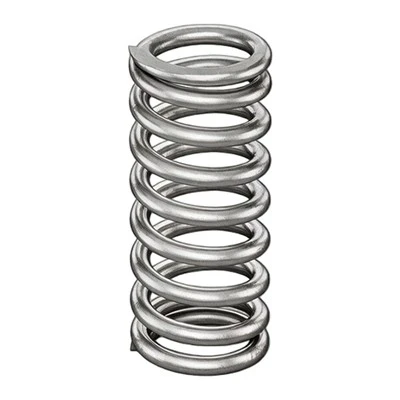
The most common formula for calculating the stiffness of a helical compression spring (which is a type of precision spring) is given by:
[ k=\frac{Gd^{4}}{8nD^{3}} ]
Here's what each variable means:
- (k) is the spring stiffness.
- (G) is the shear modulus of the spring material. Different materials have different shear moduli. For example, for steel, (G) is typically around 79 GPa (gigapascals).
- (d) is the wire diameter of the spring. This is the thickness of the wire used to make the spring.
- (n) is the number of active coils in the spring. Active coils are the coils that actually contribute to the spring's deflection.
- (D) is the mean diameter of the spring. The mean diameter is calculated as the average of the outer and inner diameters of the spring.
Let's say you're using a steel spring with a wire diameter ((d)) of 2 mm, the number of active coils ((n)) is 10, and the mean diameter ((D)) is 20 mm. The shear modulus ((G)) for steel is 79 GPa or (79\times10^{3}) N/mm².
First, we substitute the values into the formula:
[ k=\frac{79\times10^{3}\times(2)^{4}}{8\times10\times(20)^{3}} ]
[ k=\frac{79\times10^{3}\times16}{8\times10\times8000} ]
[ k=\frac{1264000}{640000}= 1.975 \text{ N/mm} ]
Considerations for Material Selection
The choice of material can significantly affect the spring stiffness. As I mentioned earlier, the shear modulus ((G)) varies depending on the material. For example, if you use a non - ferrous material like phosphor bronze, the shear modulus is around 41 GPa. Using the same spring dimensions as above but with phosphor bronze, the calculated stiffness will be different.
[ k=\frac{41\times10^{3}\times(2)^{4}}{8\times10\times(20)^{3}} ]
[ k=\frac{41\times10^{3}\times16}{8\times10\times8000} ]
[ k=\frac{656000}{640000}= 1.025 \text{ N/mm} ]
This shows that just by changing the material, the spring stiffness can change quite a bit. So, when you're designing a spring or looking for a specific stiffness, material choice is a key factor.
Different Types of Precision Springs and Their Stiffness
We offer a variety of precision springs at our supply. For instance, Vehicle Suspension Spring has a specific stiffness requirement. These springs need to be able to handle the weight of the vehicle and provide a smooth ride. The stiffness of a vehicle suspension spring is carefully calculated based on the vehicle's weight, the type of driving conditions, and the desired level of comfort.
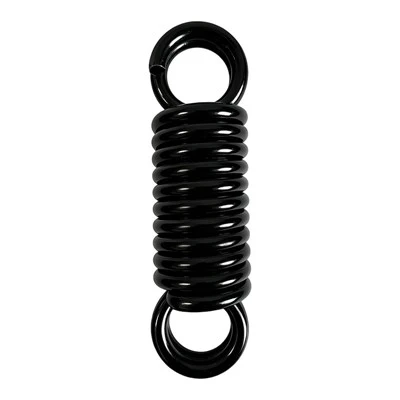
Industrial Tension Springs also have their own stiffness characteristics. These springs are designed to resist stretching and are used in various industrial applications. The stiffness of a tension spring is calculated in a similar way to a compression spring, but there are some additional factors to consider, such as the initial tension in the spring.
Specialized Springs
We also have Small Conical Springs and Small Strong Springs in our catalog. Calculating the stiffness of conical springs is a bit more complex than for regular helical springs. The varying diameter along the length of the spring means that the stiffness is not constant. You may need to use more advanced mathematical models or finite element analysis (FEA) software to accurately calculate the stiffness of conical springs.
For Small Strong Springs, the focus is often on achieving a high stiffness in a small package. This usually involves using high - strength materials and optimizing the spring's geometry.
Practical Tips for Calculating Spring Stiffness
- Measurements: Make sure your measurements of wire diameter, mean diameter, and the number of active coils are as accurate as possible. A small error in measurement can lead to a significant difference in the calculated stiffness.
- Testing: If possible, conduct physical tests on sample springs. You can use a spring testing machine to measure the actual force required to deflect the spring. Compare the test results with your calculated values to validate your calculations.
- Consult an Expert: If you're not confident in your calculations or if you're dealing with a complex spring design, don't hesitate to consult with an experienced engineer.
Importance of Getting the Stiffness Right
Getting the right spring stiffness is crucial for the proper functioning of your application. If the spring is too stiff, it may not deflect enough, leading to excessive stress on other components. On the other hand, if the spring is too soft, it may deflect too much, causing the system to malfunction.
Contact for Precision Springs
If you're in the market for Precision Spring and need assistance with calculating the stiffness for your specific application, we're here to help. Whether you're working on a vehicle suspension system, an industrial machine, or a small - scale project, our team of experts can provide you with the right springs and advice. Feel free to reach out to discuss your requirements and get started on your next project.
References
- Mechanical Engineering Design by Joseph Edward Shigley
- Spring Design Handbook by William A. Gross